
Mastering the Deal: How Lease Negotiation Services Can Save You Money
October 29, 2026 by Kevin
Why Lease Negotiation Services Can Make or Break Your Business
Lease negotiation services are professional advisory services that help business tenants secure better lease terms, avoid hidden costs, and protect their long-term financial interests when renting commercial space.
Here’s what they typically help with:
- Rent and escalation caps – keeping rent increases predictable
- Tenant improvement allowances – getting landlords to fund buildouts
- CAM charge reviews – auditing common area maintenance fees for accuracy
- Renewal and exit terms – building flexibility into the agreement
- Market comparisons – ensuring you’re not overpaying relative to similar properties
Commercial leases are complex. The average agreement contains dozens of clauses, and most are written to favor the landlord.
Without expert help, businesses routinely sign leases with unexpected cost increases, vague maintenance obligations, and limited exit options. These mistakes don’t just sting at signing — they can drain resources for the entire lease term.
The stakes are high. A commercial lease is often one of the largest financial commitments a business makes. Getting it wrong can affect everything from cash flow to day-to-day operations.
That’s why more businesses — from independent retailers to large corporations — are turning to professional lease negotiation services to level the playing field.
Understanding the Value of Professional Lease Negotiation Services
When we talk about Lease negotiation services, we are talking about more than just haggling over the monthly rent. It is a comprehensive approach to asset management and business strategy. In commercial real estate, there is a significant difference between a landlord’s broker and a tenant representative.
A landlord’s broker has a fiduciary duty to the property owner. Their job is to maximize the landlord’s profit. On the other hand, a tenant representation specialist has a fiduciary duty to you. They use market intelligence to ensure you aren’t just getting a space, but a deal that supports your business’s financial health.
By leveraging Leasing Expertise, businesses can tap into data that isn’t always available to the public. This includes “lease comps”—real-world data on what other tenants in the same building or neighborhood are actually paying, rather than just the “asking price.” In 2024 alone, global transaction volumes for these types of services reached $21.3B, covering over 119 million square feet of leased space. This scale of data allows specialists to provide commercial lease advisory services that turn real estate into a competitive advantage.
Tenant Representation vs. Landlord Brokerage
| Feature | Tenant Representation | Landlord Brokerage |
|---|---|---|
| Fiduciary Duty | To the Tenant (You) | To the Property Owner |
| Primary Goal | Minimize costs & maximize flexibility | Maximize rent & property value |
| Market Intelligence | Focuses on tenant-favorable comps | Focuses on landlord-favorable comps |
| Fee Structure | Often shared commission (no direct cost to tenant) | Paid by the landlord |
Identifying Hidden Fees in Lease Negotiation Services
One of the most dangerous parts of a commercial lease is what you don’t see on the first page. Hidden fees can quietly erode your profit margins over a five or ten-year term. Common pitfalls include uncapped Common Area Maintenance (CAM) charges and administrative fees that aren’t clearly defined.
Professional Property Management ensures that these costs are transparent. Without a cap on CAM increases, a landlord might pass through massive spikes in insurance or property taxes directly to you without warning. Expert negotiation services work to clarify these expense categories, ensuring you only pay your fair share. For instance, if you occupy 10% of a building, you shouldn’t be paying for 20% of the parking lot lighting just because the lease language was vague.
The Role of Legal Counsel in Documentation
While a broker finds the deal, a lawyer or lease specialist protects the deal. We believe that involving a Commercial Lease Review Attorney – Bridgford Law or a dedicated specialist is non-negotiable. They use standardized templates to ensure that risk is allocated fairly between the parties.
Key legal documents that require a sharp eye include:
- Estoppel Certificates: These confirm the terms of your lease to third parties (like a buyer of the building) and can accidentally trap you into terms you didn’t agree to if not reviewed.
- Sublease Rights: Your business needs might change. Having the right to sublease ensures you aren’t stuck paying for empty space if you need to downsize or move.
- Risk Mitigation: Well-executed Property Services involve drafting clauses that define exactly who is responsible if the roof leaks or the HVAC system fails.
Navigating Commercial Lease Types and Cost Structures
Understanding the “flavor” of your lease is the first step in calculating your true occupancy cost. Not all leases are created equal, and the labels can be confusing.
- Gross Leases: The “all-inclusive” option. You pay one flat fee, and the landlord covers taxes, insurance, and maintenance. It’s simple but often has a higher base rent to cover the landlord’s risk.
- Triple Net (NNN): The most common in industrial and retail. You pay a lower base rent, but you are responsible for your pro-rata share of property taxes, building insurance, and maintenance. This requires careful Asset Management to budget for fluctuating costs.
- Modified Gross: A middle ground where you and the landlord split certain expenses.
- Percentage Rent: Common in malls, where you pay a base rent plus a percentage of your monthly sales.
Strategic Tactics for Lease Negotiation Services
Negotiation is about more than just the “rent per square foot.” It’s about the “levers” you can pull to gain flexibility.
- Rent Escalations: Instead of a flat percentage increase, we often suggest tying increases to a market index or setting a “cap” (e.g., no more than 3% per year).
- Renewal Options: You should always seek the right to renew your lease at a predetermined rate or at “Fair Market Value” to prevent being forced out or price-gouged at the end of your term.
- Termination Clauses: Life happens. Negotiating a “break option” allows you to exit the lease early under specific conditions, protecting your business from unforeseen downturns.
- Facilities Maintenance: Don’t get stuck with a $20,000 bill for a broken chiller. Negotiate who handles Facilities Maintenance and set limits on your repair obligations for major building systems.
Maximizing Tenant Inducements and Allowances
Landlords want their buildings full, and they are often willing to pay to make that happen. These are called tenant inducements.
- Free Rent: It is common to negotiate several months of “rent abatement” while you are setting up your shop or office.
- Tenant Improvement (TI) Allowances: This is a bucket of money the landlord provides to help you build out your space. With proper Construction Oversight, you can ensure these funds are used efficiently to create a high-quality environment without draining your own capital.
- Moving Allowances: In some competitive markets, landlords may even contribute to your physical moving costs or IT setup fees.
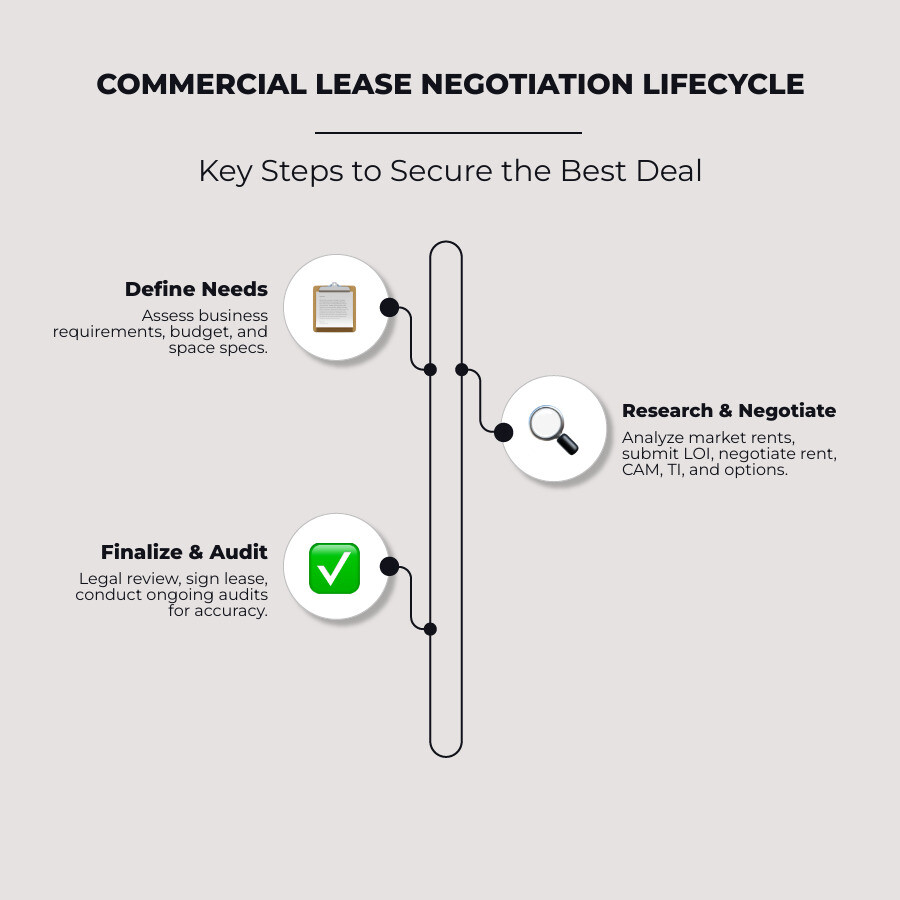
Evaluating Business Needs and Market Conditions
Before you even look at a property, you need a plan. We recommend a “needs assessment” that goes beyond just square footage. Think about your growth flexibility—will you need 20% more space in two years? What are your parking requirements?
By reviewing our Portfolio, you can see how different businesses balance location factors with space specifications. In areas like Sacramento or Reno, the “vibe” of the neighborhood can be just as important as the rent.
Researching Market Rents and Property Data
Data is your best friend in a negotiation. You need to understand:
- Historical Cycles: Is the market currently “pro-tenant” or “pro-landlord”?
- Supply-Demand Dynamics: Are there a lot of vacancies in the area? High vacancy gives you more leverage to ask for inducements.
- Landlord Reputation: Not all landlords are easy to work with. Researching the owner’s track record can save you from a “slumlord” situation.
- Neighborhood Traffic: For retail, foot traffic is everything. For office space, proximity to transit or amenities for employees is key.
At Basin Street Properties, we focus on creating “win-win” environments where both the tenant and the landlord can thrive. This philosophy is rooted in the belief that a successful lease is one that is sustainable for the long term.
Regional Variations and Compliance Standards
Leasing standards can vary significantly depending on where you are located. While our primary focus is on the US West Coast—specifically in regions like Northern California and Nevada—it’s helpful to understand how different regions handle things to see what “best practices” we can adopt.
For example, in Canada, particularly Quebec, there are very specific rules regarding lease assignments that differ from the rest of the country. Similarly, in Calgary, Bylaw 1P2007 sets strict guidelines for property use. While those specific laws don’t apply to a business in Petaluma or Reno, the lesson is the same: local zoning and compliance matter.
In our regions, such as Santa Rosa or Napa, you must be aware of:
- California Title 24: Energy efficiency standards that can impact your TI buildouts.
- ADA Compliance: Ensuring your space is accessible, which is a common area of dispute in West Coast leases.
- Local Use Permits: Just because a space looks like a restaurant doesn’t mean the city will allow you to open one there without a specific permit.
Our Team stays on top of these local nuances to ensure your lease doesn’t just look good on paper but is actually compliant with local law.
Ensuring Long-Term Protection Through Lease Audits
Your relationship with the lease doesn’t end when the ink dries. In fact, that’s just the beginning. We recommend regular lease audits to ensure billing accuracy. Common audit findings often include:
- Square Footage Verification: Are you being charged for “usable” space or “rentable” space? Sometimes the “load factor” (your share of hallways and lobbies) is calculated incorrectly.
- Duplicate Charges: Ensuring you aren’t paying for a service (like trash pickup) through your CAM fees and a direct bill.
- Annual Reviews: Conducting a check-up every year to catch errors before they become multi-year problems.
Consistent Property Management is the key to avoiding these disputes and maintaining a positive relationship with your landlord.
Frequently Asked Questions about Commercial Leasing
What is the difference between a gross lease and a triple net lease?
In a gross lease, you pay one flat monthly rate, and the landlord handles all the “extras” like taxes and insurance. In a triple net (NNN) lease, you pay a lower base rent but are responsible for your share of the building’s operating expenses. Think of gross as “all-inclusive” and NNN as “pay-as-you-go.”
Why should I hire a tenant representative instead of working with the landlord’s broker?
The landlord’s broker is legally obligated to get the best deal for the landlord. A tenant representative (or a specialist providing lease negotiation services) is your advocate. They have a fiduciary duty to you, meaning they are focused on saving you money and protecting your interests.
How can I negotiate a cap on Common Area Maintenance (CAM) charges?
You should ask for a “cumulative cap” on controllable expenses. This means the landlord can’t increase your CAM charges by more than a certain percentage (e.g., 5%) per year. This protects you from sudden spikes in costs that could hurt your cash flow.
Conclusion
Mastering the deal isn’t about “winning” at the expense of the landlord; it’s about creating a stable, predictable, and fair agreement that allows your business to grow. At Basin Street Properties, we lean on our win-win philosophy and teamwork to ensure mutual success.
By using professional Lease negotiation services, you aren’t just hiring a negotiator—you’re securing your business’s future. From identifying hidden fees to maximizing your improvement allowances, the right expertise can save you thousands of dollars and countless hours of stress.
If you’re ready to find a space that works as hard as you do, we invite you to explore More info about property services and see how we can help you navigate your next commercial lease with confidence.