
Unlock Hidden Value: A Guide to Property Portfolio Enhancement
February 27, 2026 by Kevin
Why Property Portfolio Optimization Matters Now More Than Ever
Property portfolio optimization is the strategic process of managing and reallocating resources within a real estate portfolio to maximize returns while minimizing risk. For commercial property investors and businesses, this means ensuring every asset works together to achieve your financial goals and support tenant success.
Quick Answer: What is Property Portfolio Optimization?
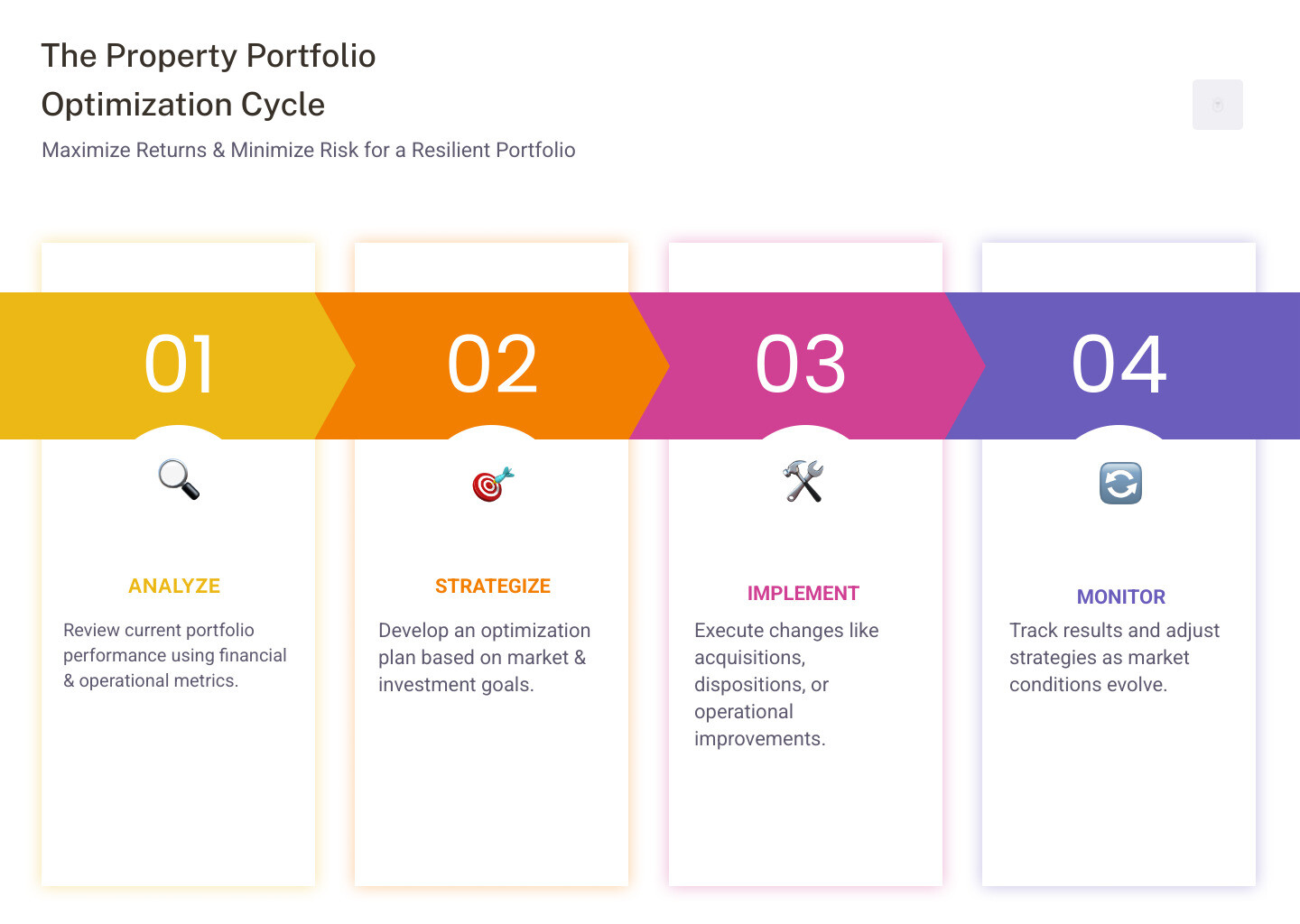
Property portfolio optimization involves:
- Analyzing current portfolio performance using financial and operational metrics
- Strategizing based on market conditions and investment goals
- Implementing changes like acquisitions, dispositions, or operational improvements
- Monitoring results and adjusting strategies as markets evolve
The core goal is aligning your real estate holdings with your business objectives while creating environments where tenants thrive.
Why does this matter right now? The commercial real estate landscape has fundamentally changed. With hybrid work reshaping office demand, office space needs could drop 20% by 2030, putting $800 billion in value at stake. Average office utilization hovers around just 40%, meaning many organizations are paying for significantly more space than they actually use.
These shifts create both challenges and opportunities. Companies can save up to $11,000 per employee annually through smart portfolio optimization. Many organizations find they can reduce their real estate footprint by 20-30% without impacting the tenant experience—simply by aligning space supply with actual demand.
But successful optimization goes beyond cutting costs. It’s about creating strategic value through diversification, risk management, and leveraging technology for data-driven decisions. The most successful investors combine financial analytics with deep market expertise to build portfolios that are both resilient and profitable.
The ‘Why’: Understanding the Value of Portfolio Optimization
Imagine your property portfolio as a well-oiled machine. Each component—every building, every lease, every tenant—plays a vital role. Property portfolio optimization is the process of fine-tuning that machine to ensure it runs at peak efficiency, delivering maximum output with minimal wear and tear.

The benefits of a well-optimized property portfolio are substantial and far-reaching. At its heart, optimization leads to improved cash flow and a stronger Return on Investment (ROI). By strategically managing assets, we can identify and address underperforming properties, reduce unnecessary expenses, and minimize vacancy rates and maintenance costs. This not only improves overall profitability but also provides better financial controls and increased efficiency.
For us, this means a positive impact on Net Operating Income (NOI), a healthier cash-on-cash return, and stronger long-term appreciation across our portfolio in locations like Mill Valley, Petaluma, Reno, and Sacramento. We’ve seen how informed decision-making regarding asset acquisition and disposal, coupled with proactive management, can lead to superior financial performance and mitigate risks.
The current market context makes this optimization even more critical. The widespread shift to hybrid work models has dramatically altered the demand for office space. While the full impact is still unfolding, projections suggest that demand for office space could be 20% lower by 2030 compared to 2019 levels. This translates to an estimated $800 billion in value at stake, with average office space values potentially declining by 26% over the same period.
We’re also seeing significant underutilization of existing office space. Statistics show that around 44% of desks are used for less than an hour daily, and average workplace utilization could hit just 40% in 2025. This means many companies are paying for significantly more space than they actually need—a costly oversight.
The good news? This presents a massive opportunity for cost savings. Many organizations find they can reduce their real estate footprint by 20-30% without negatively impacting the employee or tenant experience. This is achieved simply by aligning space supply with actual demand rather than relying on outdated assumptions. Corporate real estate optimization, particularly through hybrid work models, can save companies up to $11,000 per employee annually. These are not just theoretical savings; they are tangible improvements that directly boost the bottom line.
Beyond the numbers, optimization ensures that our real estate assets are strategically aligned with our overall business goals. It’s about having the right properties in the right places, operating efficiently, and providing superior tenant experiences. This strategic alignment is a competitive advantage, helping us create enduring relationships and mutual success.
More info about our asset management services.
A Step-by-Step Guide to Property Portfolio Optimization
Starting on property portfolio optimization can feel like a big undertaking, but by breaking it down into manageable steps, we can steer the process effectively. It’s a dynamic journey, not a one-time event, requiring careful planning, execution, and continuous refinement.
Step 1: Comprehensive Portfolio Audit
The first and most crucial step is to get a crystal-clear picture of our current holdings. This involves a thorough audit where we gather comprehensive data on every real estate asset. We look at everything: location, size, current utilization, lease terms, operational costs, and market value. This current state assessment goes beyond just financials; it evaluates how each property aligns with our broader business objectives and tenant needs. Are there properties in Reno or Santa Rosa that are underperforming? Are our assets in Napa or Novato truly supporting our strategic vision? This detailed review helps us identify strengths, weaknesses, and performance patterns across the entire portfolio.
Step 2: Strategic Goal Setting
With a clear understanding of our current portfolio, the next step is to define our investment thesis and set clear, measurable goals for optimization. What do we want to achieve? Is it enhancing risk-adjusted returns, reducing volatility, improving operational efficiency, or perhaps a combination of these? We need to identify target returns, cash flow requirements, and establish a realistic timeline for achieving our objectives. These goals will guide every subsequent decision and ensure our optimization efforts are purposeful and aligned with our long-term vision.
Step 3: Developing the Optimization Strategy
Now, we move from assessment to action planning. This step involves identifying specific strategies custom to our goals. We categorize our assets: which ones are unsupportive (no longer adding value), which are supportive (contributing positively but could be improved), and where are the missing gaps or opportunities? For unsupportive assets, we might consider divestment. For supportive ones, we look at optimizing their performance through lease renegotiations, operational efficiencies, or capital improvements. To fill gaps, we might identify opportunities for expansion or acquisition in growing markets like Sacramento or Petaluma. This is where we consider various approaches, from rebalancing property types to optimizing capital structures.
Step 4: Implementation and Execution
This is where the rubber meets the road. Based on our strategic plan, we execute the identified changes. This could involve renegotiating lease agreements to secure more favorable terms, selling underperforming assets, acquiring new properties that strengthen our portfolio, or optimizing space utilization within existing buildings. For instance, we recently fortified our presence with acquisitions like Basin Street Properties Acquires Thomas Creek Business Center in South Reno, showcasing our commitment to strategic growth and property improvement. This stage also includes implementing property management best practices and making necessary capital improvements to improve asset value and tenant experience.
Step 5: Continuous Monitoring and Adjustment
Property portfolio optimization is not a one-and-done deal. The real estate market is constantly evolving, influenced by economic shifts, technological advancements, and changing tenant demands. Therefore, continuous monitoring is essential. We track key performance indicators (KPIs), regularly review our portfolio’s performance against our established goals, and make adjustments as needed. This feedback loop allows us to respond proactively to market changes, business needs, and emerging opportunities.
Of course, this journey isn’t without its problems. Common challenges include ensuring data quality across diverse assets, navigating market volatility, and finding the delicate balance between cost reduction and maintaining a superior tenant experience. However, by adhering to a structured, data-driven approach, we can overcome these challenges and open up significant value.
Key Strategies: Diversification and Risk Management
At the heart of a resilient and profitable property portfolio lies a robust strategy for diversification and proactive risk management. Just as a balanced diet is good for your health, a balanced portfolio is good for your wealth.
Diversification is about spreading investments across different categories to reduce overall risk. For us, operating in diverse Northern California markets from Mill Valley to Suisun, this means:
- Geographic Diversification: We look beyond a single city. While we might have a strong presence in Reno or Sacramento, we also consider complementary markets that might respond differently to economic shifts. This approach helps buffer against localized downturns.
- Property Type Diversification: While our primary focus is commercial office space, a broader portfolio might include residential, industrial, or mixed-use properties. This helps ensure that if one sector faces headwinds, others can provide stability.
- Asset Class Balancing (Core, Value-Add, Opportunistic): We strategically balance our investments. “Core” assets provide stable income, “Value-Add” properties offer potential for increased returns through improvements, and “Opportunistic” investments target higher returns but come with higher risk. This blend allows us to align with various market cycles and investment objectives.
Risk Management is equally critical. We proactively identify potential threats and implement strategies to mitigate them. Key risks in real estate include:
- Market Downturns: Economic recessions or shifts in demand can impact property values and occupancy rates.
- Tenant Vacancies: High vacancy rates directly hit cash flow.
- Interest Rate Changes: Fluctuating interest rates can affect financing costs and property valuations.
- Natural Disaster Exposure: Given our locations, assessing natural disaster exposure is a crucial part of our risk analysis.
To counter these risks, we employ various mitigation strategies. These include maintaining healthy cash reserves for unexpected expenses, and structuring flexible lease agreements with options for expansion or favorable termination clauses. Our goal is to build a portfolio that can weather any storm, ensuring long-term stability and growth.
Measuring Success: KPIs for an Optimized Portfolio
How do we know if our property portfolio optimization efforts are paying off? By tracking the right Key Performance Indicators (KPIs). These metrics provide a clear, data-driven picture of our portfolio’s health and performance.
Here are some of the essential KPIs we monitor:
- Financial Metrics:
- Return on Investment (ROI): Measures the profitability of our investments.
- Cash Flow: Crucial for liquidity and understanding the actual money generated by properties.
- Occupancy Rates: The percentage of occupied space, directly impacting rental income.
- Property Valuation: Regular assessments of asset market value to track appreciation.
- Operational Metrics:
- Cost per Employee: For corporate real estate, this helps gauge efficiency of space usage relative to workforce.
- Space Efficiency Ratios: How effectively space is used, often measured by square footage per person.
- Tenant Retention Rate: A high retention rate indicates tenant satisfaction and reduces turnover costs.
- Portfolio-Level Metrics:
- Sharpe Ratio: Measures risk-adjusted return, helping us understand how much return we’re getting for the risk we’re taking.
- Portfolio Beta: Indicates the sensitivity of our portfolio’s returns to overall market returns.
- Diversification Quotient: Quantifies how well our portfolio is diversified across different assets and markets.
By consistently tracking these KPIs, we gain actionable insights that allow us to make informed decisions, adjust our strategies, and ensure our portfolio remains on track to meet our financial and strategic objectives.
Leveraging Technology for Smarter Decisions
Gone are the days when property portfolio optimization relied solely on spreadsheets and gut feelings. The evolution of real estate management has been nothing short of revolutionary, moving from manual data entry to sophisticated, AI-powered platforms. This technological leap means we can now make smarter, faster, and more informed decisions.

The role of data analytics is paramount in this change. Advanced analytics tools allow us to dissect and understand complex market trends, identify subtle patterns, and create predictive models. This enables scenario planning, helping us anticipate future market conditions and potential risks, rather than just reacting to them. Imagine knowing a neighborhood in Santa Rosa or Vacaville is getting hot before prices start rising, just by tracking foot traffic patterns or social media sentiment. That’s the power of data-driven insights.
AI and Big Data are at the forefront of this revolution. Big Data provides comprehensive insights into the market by analyzing vast datasets, identifying patterns, and predicting trends that inform investment decisions. This leads to better portfolio diversification and stronger returns. Artificial Intelligence, meanwhile, is revolutionizing dynamic asset allocation, allowing our investment strategies to adapt in real-time to market changes. AI can automate valuations, analyze market sentiment, and even create dynamic strategies that optimize performance while minimizing risk. For instance, the integration of Wi-Fi tracking, Internet of Things (IoT) devices, and temperature sensors is improving office space management by enabling real-time monitoring of conference rooms and hybrid spaces in our properties. This real-time data, analyzed by AI, helps optimize space utilization, reduce operational costs, and improve the tenant experience.
Our modern tech stack for property portfolio optimization includes:
- Property Management Software: Streamlines operations, lease administration, financial reporting, and tenant communication.
- IoT Sensors: Devices that provide real-time data on space utilization, energy consumption, and environmental conditions within our buildings.
- Data Analytics Platforms: Tools that process, visualize, and interpret large volumes of data to provide actionable insights.
Leveraging these technologies allows us to move beyond traditional dashboards and gain a holistic view of our portfolio’s performance, driving agile and responsive decision-making. Here’s how you can optimize your property portfolios using strategic decision making.
The Mathematics Behind Property Portfolio Optimization
While technology provides the tools, the underlying principles of property portfolio optimization are often rooted in sophisticated mathematical models. One of the most influential frameworks is Modern Portfolio Theory (MPT), pioneered by Harry Markowitz.
MPT, when adapted for real estate, helps us construct portfolios that maximize expected returns for a given level of market risk. The core idea is mean-variance optimization, where the goal is to find the optimal allocation of assets that offers the highest possible return for a chosen level of risk, or the lowest possible risk for a desired level of return.
This concept leads to the Efficient Frontier, a graphical representation of optimal portfolios. Any portfolio lying on the efficient frontier offers the best possible risk-return trade-off. Portfolios below the frontier are suboptimal, as they offer less return for the same risk, or more risk for the same return. For property assets, this means carefully selecting properties in our portfolio—whether in Reno, Sacramento, or Novato—that, when combined, create a portfolio that is more resilient and higher-performing than individual assets alone. By measuring property risk and calculating correlations between different assets, we can plot our own “efficient frontier” for real estate.
Understanding these mathematical underpinnings allows us to build a robust, scientifically backed approach to property portfolio optimization, moving beyond guesswork to data-driven strategic allocation. For those interested in the foundational concepts, Markowitz’s foundational 1952 paper on Portfolio Selection remains a cornerstone of this field.
The Future of Portfolio Management: Global and Sustainable Trends
The landscape of property portfolio optimization is continuously evolving, shaped by powerful forces such as globalization and a growing emphasis on sustainability. These trends are not just buzzwords; they are fundamental shifts that influence investment strategies and asset management practices.
Globalization’s impact on real estate investment strategies means a broader perspective is needed, even for regionally focused portfolios like ours. While our direct investments are in Northern California, global economic shifts, cross-border capital flows, and international regulations indirectly influence local markets in places like Santa Rosa, Napa, and Folsom. A global perspective helps us understand broader market dynamics and how they might impact local demand, pricing, and investment opportunities. It brings a complex set of market and regulatory factors into consideration for real estate investments, requiring us to adapt our strategies to these diverse and dynamic environments.
Sustainable asset management is no longer optional; it’s a strategic imperative. We are seeing a strong trend towards integrating ESG (Environmental, Social, and Governance) criteria into real estate portfolios. This means focusing on:
- Green Building Certifications: Pursuing certifications like LEED or BREEAM for our properties not only reduces environmental impact but also improves marketability and tenant appeal.
- Reducing Carbon Footprint: Implementing strategies to lower greenhouse gas emissions from our buildings.
- Energy Efficiency Upgrades: Investing in energy-efficient systems and technologies, which leads to reduced operational costs and increased asset value.
- Renewable Energy Integration: Exploring options for incorporating renewable energy sources into our properties.
These sustainable practices reflect a growing commitment to environmental stewardship and are increasingly seen as essential for long-term value and responsible growth.
Finally, client-centric approaches and personalization are becoming key differentiators. In today’s competitive environment, enhancing the tenant experience is paramount. This involves:
- Flexible Workspaces: Adapting office layouts to support hybrid work models, offering a mix of collaborative zones, quiet areas, and ergonomic workstations.
- Data-Driven Amenity Programming: Using data to understand tenant demographics and preferences, allowing us to offer amenities and services that truly add value.
- Superior Tenant Experiences: Focusing on the overall experience, from seamless property management to fostering a sense of community.
By prioritizing our tenants’ needs and creating environments where they can thrive, we build enduring relationships and ensure our properties remain attractive and highly used. More info about our leasing expertise.
Frequently Asked Questions about Property Portfolio Optimization
We often hear similar questions from investors and property managers considering property portfolio optimization. Here are some of the most common ones:
What is the first step in optimizing a real estate portfolio?
The very first step is to clearly define your investment thesis and strategic goals. Before you can optimize anything, you need to know what you’re optimizing for. This involves a comprehensive current state assessment of your existing assets, understanding their performance, and identifying how they align with your business objectives. It’s about setting clear goals for what you want your portfolio to achieve in terms of returns, risk tolerance, and operational efficiency.
How often should a property portfolio be reviewed?
A property portfolio should be reviewed regularly, not just when market conditions demand it. While an annual, comprehensive review is a good baseline, we recommend more frequent assessments, especially in dynamic markets or when significant business changes occur. Quarterly or even monthly check-ins on key performance indicators (KPIs) can help you stay agile and make proactive adjustments. The goal is to routinely revisit, reevaluate, and reoptimize your portfolio to ensure it remains aligned with your evolving goals and market realities.
Can portfolio optimization apply to a small number of properties?
Absolutely! The principles of property portfolio optimization are scalable and apply regardless of the size of your holdings. Whether you manage two properties or twenty, the concepts of maximizing returns, minimizing risk, strategic diversification, and leveraging data for informed decisions are equally relevant and beneficial. For smaller portfolios, optimization might involve simpler analyses, but the strategic thinking remains the same: making each asset work as hard and smart as possible towards your overall objectives.
Conclusion: Building a Resilient and Profitable Portfolio
As we’ve explored, property portfolio optimization is a critical, ongoing strategic process for any investor or property manager looking to thrive in today’s dynamic real estate landscape. It’s about more than just cutting costs; it’s about proactively enhancing value, mitigating risks, and ensuring every asset contributes to your overarching business goals.
The journey requires a delicate balance of robust data analytics, a clear strategic vision, and deep market expertise. From conducting thorough audits and setting precise goals to implementing diversified strategies and leveraging cutting-edge technology like AI and Big Data, each step plays a vital role. We’ve also seen how global trends in sustainability and client-centric approaches are shaping the future, making our portfolios not just profitable but also responsible and adaptable.
Crucially, we must never underestimate the human factor. While technology provides powerful tools, it’s the intellectual input, experience, and savoir-faire of a skilled team that truly propels optimization efforts forward. Our experience shows that maximizing a property portfolio is impossible without competent individuals guiding the process.
At Basin Street Properties, our approach is centered on creating mutual success through strategic asset management and superior tenant experiences. We believe that by applying these principles of property portfolio optimization, we can build resilient, high-performing portfolios that deliver exceptional value for years to come.