
A Practical Guide to Managing Commercial Property
October 15, 2026 by Kevin
What Managing Commercial Property Actually Involves (And Why It Matters)
Managing commercial property well is one of the most direct ways to protect and grow the value of a real estate investment – but it demands far more than collecting rent and scheduling repairs.
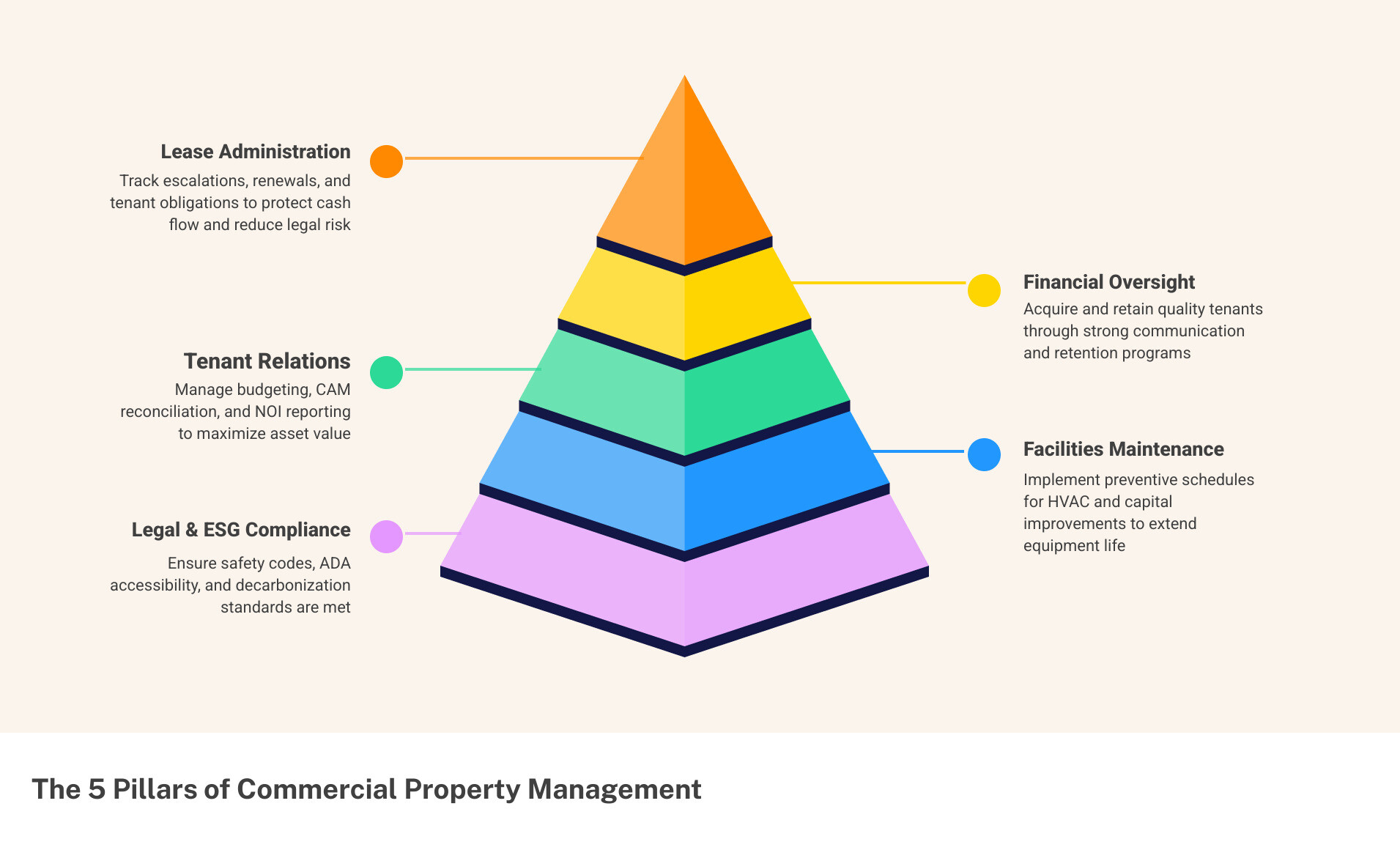
Here’s what effective commercial property management covers at a glance:
- Lease administration – tracking escalations, renewals, and tenant obligations
- Financial oversight – budgeting, CAM reconciliation, and NOI reporting
- Tenant relations – acquisition, retention, and day-to-day communication
- Facilities maintenance – preventive schedules, HVAC, and capital improvements
- Legal and regulatory compliance – safety codes, ADA, and ESG standards
For businesses and investors operating in Northern Nevada (Reno, Sparks, Fernley) and Northern California, finding the right commercial property management approach for multifamily, apartment, and flex space assets can mean the difference between a thriving investment and a costly vacancy spiral.
The stakes are real. Losing a single commercial tenant or experiencing elevated apartment turnover can run into the hundreds of thousands of dollars once you factor in lost rent, tenant improvement costs, and leasing commissions – not to mention the months it can take to re-lease a space. According to the National Association of Realtors, the commercial real estate sector remains a major part of the U.S. economy, leaving very little room for reactive or disorganized management.
Whether you own multifamily communities, apartment complexes, or flex space, this guide walks through the practical strategies that keep properties performing – and tenants staying.
Core Strategies for Managing Commercial Property
When we talk about managing commercial property, we are looking at a discipline that requires specialized expertise across asset types. Whether overseeing a multifamily community or a flex space, management is a business-to-business and business-to-resident partnership. We are not just managing “units”; we are managing assets that must produce a return on investment for the owner while providing a functional, high-performing environment for tenants and residents.
The core of our strategy revolves around maximizing Net Operating Income (NOI). This is achieved through a careful balance of rent optimization, expense control, and strategic capital improvements. In the current market of May 2026, well-managed properties consistently outperform reactive assets because they are operated as active business environments rather than static buildings.
| Feature | Multifamily/Apartment Management | Flex Space Management |
|---|---|---|
| Clientele | Residents/Households | Businesses/Organizations |
| Lease Terms | Typically 6-12 months | 3-10+ years |
| Complexity | Standardized leases with regulatory requirements | Highly customized (20-50+ pages) |
| Maintenance | Responsive/life-safety and amenity focus | Proactive/system-performance focus |
| Financials | Rent collection and utility management | Complex CAM/NNN reconciliations |
Effective management balances immediate operational needs with a long-term strategic vision, ensuring that every asset reaches its full potential through proactive oversight.
Defining the Scope: Multifamily, Apartments, and Flex Space
In our regions of Northern Nevada and Northern California, the management needs vary significantly depending on the asset class.
- Multifamily and Apartment Communities: In cities like Sacramento and Santa Rosa, multifamily properties continue evolving to meet resident expectations around amenities, digital connectivity, and well-maintained common areas. Resident experience is a key driver of occupancy and renewal rates.
- Flex Space: This is a growing sector in Reno, Sparks, and Fernley. Flex properties combine office space with warehouse or light operational space. These assets require specialized attention for loading areas, circulation, and higher-capacity building systems.
Regardless of the type, the goal remains the same: meet the owner’s goals while ensuring the property meets modern standards. For those looking for regional expertise, understanding local market conditions is essential for maintaining high-performing assets.
The Financial Realities of Managing Commercial Property
Financial management is the backbone of any successful asset. For flex spaces, commercial income often involves complex structures like Triple Net (NNN) leases, where tenants pay for their share of taxes, insurance, and maintenance. For multifamily and apartment assets, revenue management focuses on market-rate optimization, concession strategies, and ancillary income.
We prioritize meticulous Asset Management to ensure that every dollar spent is an investment in the building’s future. This includes:
- Budgeting: Creating annual operating budgets and long-term capital expenditure (CapEx) plans.
- CAM Charges: For flex properties, Common Area Maintenance (CAM) reconciliation is a frequent pain point. We ensure these are calculated transparently and accurately to maintain tenant trust.
- Rent Collection: Whether for apartment residents or flex tenants, rent collection involves tracking escalations, often tied to CPI or fixed percentages, and managing late fees professionally.
Lease Administration and Tenant Retention
Lease administration is the back-office engine of managing commercial property. For flex spaces, a single missed escalation clause in a 50-page lease can cost an owner tens of thousands of dollars annually. For multifamily assets, tracking lease expirations and staggering renewals is critical to maintaining stable occupancy. We utilize specialized Leasing Expertise to track critical dates, such as renewal options, expansion rights, and rent adjustments.
Commercial and multifamily leases also involve fit-for-purpose obligations. This means the space must be maintained to a standard that supports the tenant’s or resident’s needs. If an apartment community’s HVAC fails during a Petaluma summer, it is not just an inconvenience; it is a livability issue that could lead to turnover and legal liability.
Tenant and Resident Acquisition in Northern California and Nevada
Finding the right tenant or resident is just as important as filling a vacancy. In markets like Reno, Sparks, Fernley, and Sacramento, we look for vetted tenants – businesses with strong credit for flex spaces, and qualified residents for multifamily communities – that complement the existing tenant mix and community.
We often leverage broker partnerships and targeted marketing to ensure properties are seen by the right audience. Understanding current market conditions, absorption trends, and local demand drivers helps owners position space more effectively and reduce downtime.
Strategies for Long-Term Tenant Retention
Retention is where the real profit is made. It is significantly cheaper to keep a tenant or resident than to find a new one. Strong retention is achievable through responsive service and proactive communication.
- Feedback Loops: We do not wait for a problem to arise. Regular check-ins and satisfaction surveys help catch small issues before they become lease-ending disputes or move-outs.
- Amenity Programs: Modernized multifamily communities and flex properties with strong common-area experiences tend to see stronger renewal activity.
- Responsive Maintenance: When a tenant or resident submits a request, a fast, professional response builds the trust necessary for a long-term partnership.
For more on building these relationships, focusing on tenant-centric oversight offers excellent strategies for long-term success.
Operational Excellence and Facilities Maintenance

Operations are the physical manifestation of your management strategy. A well-executed Facilities Maintenance program can reduce total maintenance costs and extend the life of critical equipment.
In Northern Nevada, where temperatures can swing sharply, HVAC maintenance is not optional – whether for a multifamily community or a flex property. We move away from break-fix mentalities toward predictive and preventive schedules. This helps ensure that building systems – elevators, fire life safety, and plumbing – are performing at peak efficiency.
Proactive Maintenance and Capital Improvements
Strategic Construction Oversight is essential when planning capital improvements. Whether it is an amenity renovation at a Reno apartment community or a parking lot resurfacing at a Sparks flex property, these projects must be managed to minimize tenant and resident disruption while maximizing ROI.
Proactive maintenance does not just save money on repairs; it protects the property’s curb appeal. A modernized building with updated fixtures and clean common areas attracts stronger tenants and residents and supports rental rate growth.
Safety, Compliance, and ESG Standards
As of 2026, Environmental, Social, and Governance (ESG) standards have moved from nice to have to essential. Compliance now involves more than just fire codes and ADA accessibility; it also includes energy efficiency tracking and decarbonization planning.
In Nevada and California, professional management teams must navigate increasingly complex regulatory environments. Managers need consistent documentation – from safety inspections to energy performance records – to reduce risk, avoid penalties, and meet the expectations of institutional owners and sustainability-minded tenants and residents.
Modern Tools and Professional Oversight
The days of managing a portfolio with a spreadsheet are over. Modern managing commercial property requires a robust PropTech stack.

Leveraging Technology for Managing Commercial Property
We use data-driven platforms like Yardi and MRI Software to unify building systems into a single operational view.
- IoT Sensors: These can detect water leaks or HVAC anomalies before they cause damage – critical for both multifamily communities and flex properties.
- Real-time Reporting: Owners can see property performance, from rent collection to work order status, at any time.
- Automation: Automating rent increases, lease renewal reminders, and late fee notifications reduces administrative burden and limits human error.
Professional management teams use these technologies to deliver stronger market insight, faster response times, and greater operational efficiency across multifamily and flex portfolios.
Hiring Professional Management vs. In-House Teams
For many owners, the question is whether to manage in-house or hire a professional firm. While managing in-house may appear cost-effective, it often leads to uneven operations and missed opportunities.
Professional Property Services provide:
- Volume-based Discounts: We can often secure better vendor pricing through portfolio scale.
- Legal Protection: We stay current on changing laws in California and Nevada to help protect owners from liability.
- Operational Efficiency: Professional management reduces day-to-day friction and gives owners clearer reporting, stronger controls, and more consistent execution.
If you are considering outsourcing, professional management services can help you evaluate the benefits for your specific multifamily or flex space portfolio.
Frequently Asked Questions about Commercial Management
What are typical commercial property management fees?
Fees generally range from 2% to 8% of gross collected rent. This varies based on the property type and size. For example, a large multifamily community in Sacramento might have a lower percentage fee than a smaller flex property in Fernley. Owners should also expect additional costs for leasing commissions and construction management fees for major projects.
How do CAM charges differ from base rent?
Base rent is the “sticker price” for the space itself. CAM (Common Area Maintenance) charges are the tenant’s pro-rata share of operating the building. This includes landscaping, security, cleaning of common areas, and insurance. In a Triple Net (NNN) lease – common in flex spaces – these are passed through directly to the tenant, ensuring the owner’s NOI remains protected from rising operating costs. In multifamily properties, these costs are typically factored into the overall rent structure.
Why is tenant retention more critical in commercial and multifamily management?
In multifamily, turnover involves unit preparation, marketing, and potential concessions that add up quickly across a large community. In flex spaces, a vacancy can last 6 to 18 months. The “turnover cost” is massive, often involving hundreds of thousands of dollars in Tenant Improvements (TI) to customize the space for a new occupant, plus significant broker commissions. This is why we prioritize tenant and resident satisfaction as a core financial strategy.
Conclusion
At Basin Street Properties, we believe that managing commercial property is about more than just oversight—it’s about partnership. Our win-win philosophy ensures that we create superior tenant and resident experiences that lead to enduring relationships and mutual success.
Whether you are looking for management of multifamily communities and apartment assets in the bustling markets of Reno and Sparks, flex space in Fernley, or established multifamily corridors of Northern California, our team is dedicated to maximizing your asset’s value through teamwork and operational excellence.
Ready to elevate your investment? Contact our team today or Explore our Property Management services to see how we can help you achieve your goals in 2026 and beyond.